
By Orlianis D. Oliveras Muñoz
Journalism Student
Rain fell across the hallways of Universidad del Sagrado Corazón when Doris Pizarro arrived at the Student Center. There was no formal introduction. She walked over and, before any questions were asked, embraced the journalist. That is how the conversation began: without distance, without protocol. That first gesture set the tone for the encounter and foreshadowed the way Pizarro relates to others.
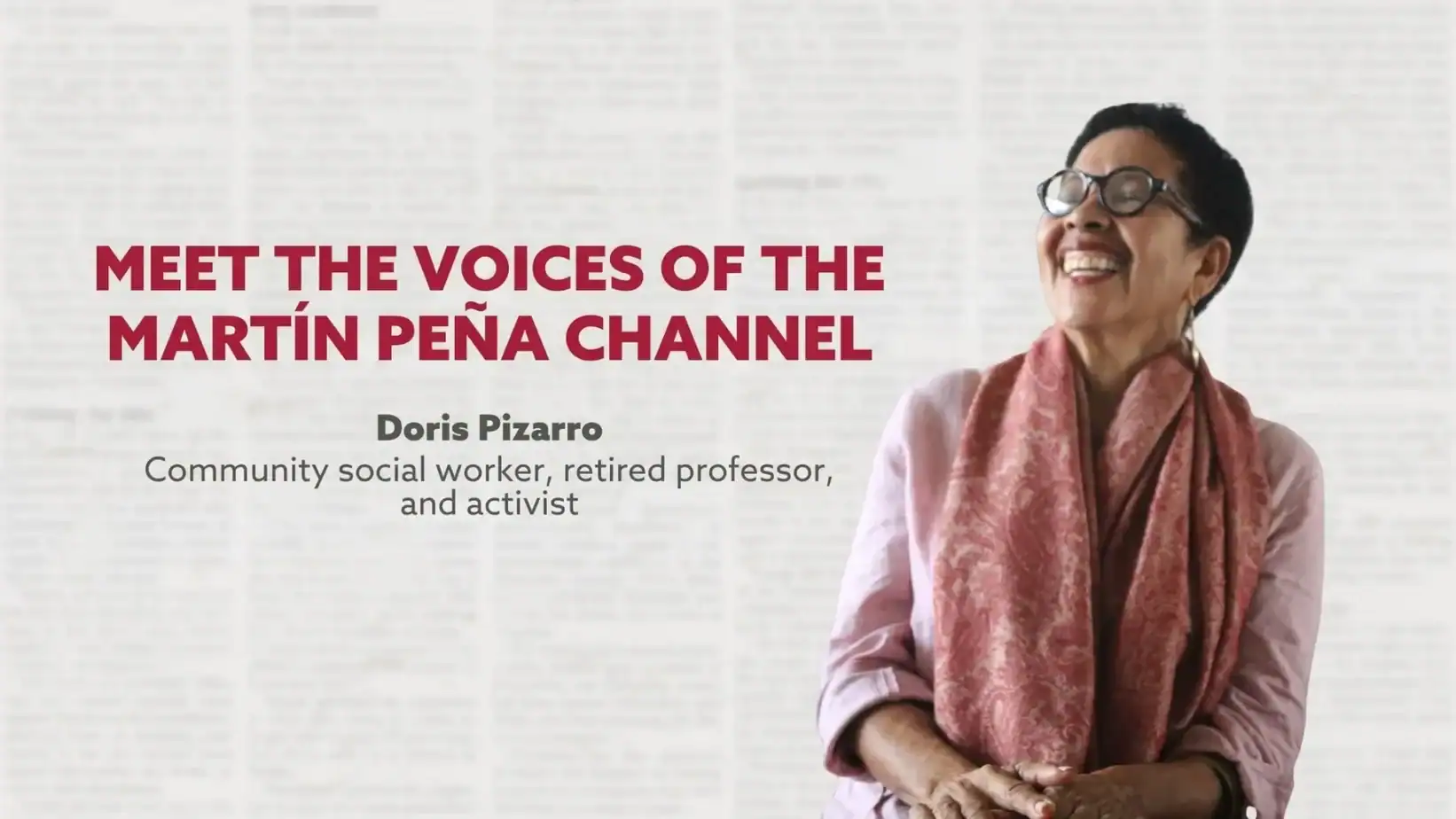
A community social worker, retired professor, and activist, Pizarro does not define herself through titles, but through closeness. Throughout the meeting, her way of speaking shifts depending on what she is remembering. When she talks about her childhood, she smiles. “Poor, but happy,” she says while describing her early years. The phrase captures a period marked both by hardship and by family unity.
She grew up in a large family, where sharing was part of everyday life. Beyond the lack of resources, she explains that her home fostered an environment where independent thinking and decision-making were encouraged. That atmosphere shaped the way she began to understand her surroundings from an early age and helped her develop a critical perspective on what was happening around her.
Her tone changes when she speaks about other experiences. She pauses, slows down, and carefully measures her words. She recalls a moment at school that she still remembers vividly. She wanted to portray the Virgin Mary in a school activity, but the teacher refused. “The Virgin Mary was blonde, white, and blue-eyed,” they told her. She neither dramatizes nor softens the memory. She pauses before continuing, as if that moment still carries weight in her mind.
“I was born asking why.”
That questioning runs throughout her story. From an early age, it translated into action. By the age of 13, she was already involved in student movements. “I became politically active before I even became a young lady,” she says naturally. In her telling, that step does not appear isolated, but rather as part of a process already unfolding.
Her years at the university were marked by that same drive. She participated in political struggles and organizing efforts that eventually led to her expulsion. She does not describe it as a rupture or a defeat, but as part of a broader journey. “That was part of the process,” she says about that stage of her life.
From that point on, her work shifted toward other spaces. Communities, labor unions, and organizations became the center of her life. She participated in community organizing processes and social struggles that often go undocumented and publicly unrecognized. When she speaks about these experiences, her tone becomes firmer. “That’s where I truly learned,” she says in reference to grassroots work, emphasizing the value of learning outside formal institutions.
Throughout that journey, one idea remains constant: “I never do anything alone.” The phrase is not presented as a slogan, but as a practice. Every experience she mentions is tied to collective work, shared processes, and collaboration with others. “The work is collective,” she affirms.
“Communities are the ones that save this country.”
The statement is direct. She does not elaborate on it at that moment, but it resonates throughout her entire narrative, where the emphasis always falls on community work and collective organizing as engines of change.
Her trajectory also includes experiences outside Puerto Rico, such as her work in Cuba and her participation in international spaces connected to political and social processes. Even when speaking about those moments, she maintains the same perspective: she does not place the emphasis on the individual, but on shared processes. “It’s not about one person,” she says, reinforcing that vision.
Over time, she returned to Caño Martín Peña, the place that shaped her beginnings. She does not describe that return as an isolated decision, but as a continuation of her path. When asked why she came back, she responds: “Love… and a sense of justice.”
Today, she remains connected to community work. She participates in projects, collaborates with local initiatives, and maintains an active presence in different spaces. Still, she avoids the spotlight. She explains that she learned to “sit in the third row,” a way of describing her role within collective processes without placing herself at the center.
As the interview progresses, it becomes clear that her story is not divided into isolated stages. Childhood, education, activism, and community work are all part of the same continuous thread that has endured over time.
As the conversation nears its end, the rain begins to ease. The light slowly changes at Universidad del Sagrado Corazón. They gather their belongings and prepare to leave.
When Pizarro notices that the journalist plans to walk home, she offers her a ride. The two leave campus together in her car, and the conversation continues, this time without the recorder. While they wait for the journalist’s grandfather to arrive, Pizarro keeps sharing stories, just as she had throughout the interview, without the ending marking any shift in the way she relates to others.
That moment confirms what had been evident from the beginning: her way of interacting does not end within the space of the interview, but continues into everyday life.
Editor’s Note
This journalistic profile is the result of in-service learning experiences carried out as part of the course PER 223: Narrative Journalism, taught by Professor Mariliana Torres Pagán in collaboration with Sagrado’s Community Engagement Program, the Barrio Obrero Oeste se Reinventa Foundation, and the Caño Martín Peña Enlace Project.