
The study challenges aspects of the energy balance model and offers new perspectives on how body weight and metabolism are understood.

By Institutional Communication
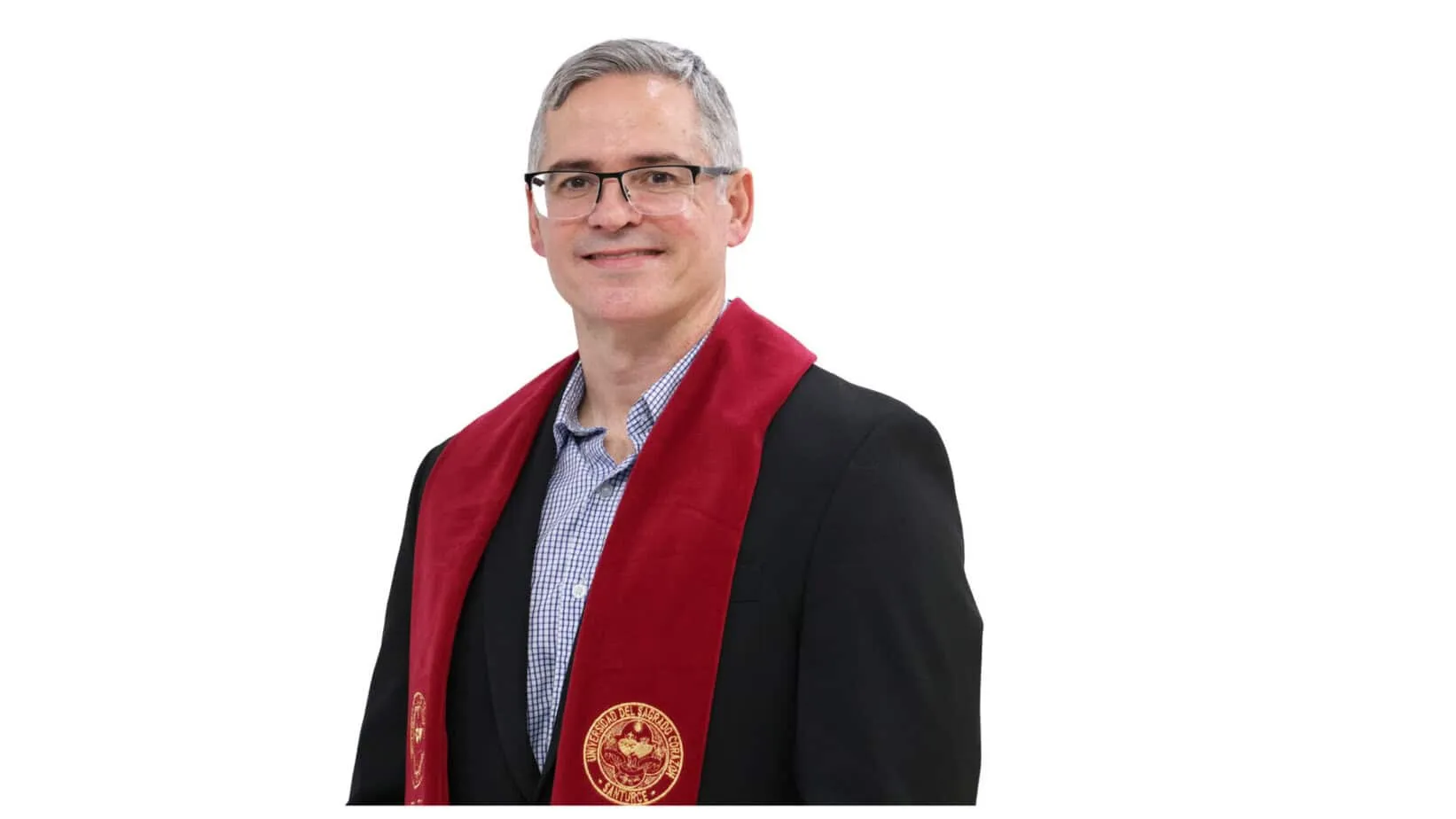
Dr. Francisco Arencibia-Albite, an alumnus and professor at Universidad del Sagrado Corazón’s School of Health and Sciences, has published a new study in the scientific journal Frontiers in Nutrition that examines the foundations of the energy balance model (EBM), a widely used framework for designing, analyzing, and interpreting research on obesity, eating disorders, and metabolic diseases.
The article, titled “A numerical and analytical evaluation of the consistency of the energy balance model identifies limitations and systematic relationships between intake and body weight dynamics,” builds on a line of research the professor has pursued at Sagrado. The study reanalyzes data from two studies led by Dr. Kevin Hall at the National Institutes of Health (NIH) and published in Nature Medicine and Cell Metabolism.
According to Dr. Arencibia-Albite’s analysis, the fundamental principles of the energy balance model are not supported by the data examined, even when variables such as food intake, physical activity, and energy expenditure are measured with a high degree of precision using metabolic chambers.
The study identifies two findings that, if confirmed through further research, “could redefine fundamental aspects of nutrition and metabolism.” The energy balance model is widely used internationally to inform public health recommendations and policies related to the prevention and treatment of eating disorders, metabolic diseases, and obesity.
First, the experimental data are consistent with predictions made by the mass balance model proposed by Dr. Arencibia-Albite in a 2020 article published in Heliyon.
“To the best of my knowledge, this is the first demonstration in the literature that fluctuations in body weight are compatible with the principle of conservation of mass rather than the principle of conservation of energy,” the professor explained.
Second, Dr. Arencibia-Albite presents a new mathematical demonstration that differs from the approach he published in the Journal of Theoretical Biology in 2022. This analysis identifies what he describes as an internal inconsistency within the energy balance model.
According to the researcher, quantitative analysis of the model based on its fundamental principles leads to a contradiction.
“Under conditions of energy balance, the model simultaneously predicts that body weight remains stable and that it decreases over time. This contradiction suggests that the problem lies not solely in the accuracy of experimental measurements, but in the mathematical structure of the paradigm itself,” he said.
The research reflects Dr. Arencibia-Albite’s interdisciplinary academic career, which integrates mathematics, biology, physiology, and biophysics.
After graduating from Sagrado with bachelor’s degrees in Exercise Science and Health Promotion, Biology, and Mathematics, he earned a master’s degree in Physiology from Universidad Central del Caribe. He later completed a doctorate in Physiology and Biophysics at the University of Puerto Rico’s Medical Sciences Campus in 2013.
His research focuses on applying mathematical reasoning and quantitative analysis to questions in the biomedical sciences, particularly models that seek to explain body weight dynamics and metabolism.
At Universidad del Sagrado Corazón, this research underscores the institution’s commitment to interdisciplinary scholarship and to generating knowledge from Puerto Rico with international impact. Dr. Arencibia-Albite’s work demonstrates how perspectives from multiple scientific disciplines can be brought together to examine complex questions and contribute new insights into health and well-being.
Learn more about the research in Frontiers in Nutrition.
Related stories
Sagrado honors Dr. Francisco Arencibia-Albite’s promotion

Sagrado Professor Opens Doors in the Field of Science at the International Level