
The discussion invited the university community to reflect on the implications of sports beyond the results on the field.
By Marcela Jiménez Ruiz
Journalism Student
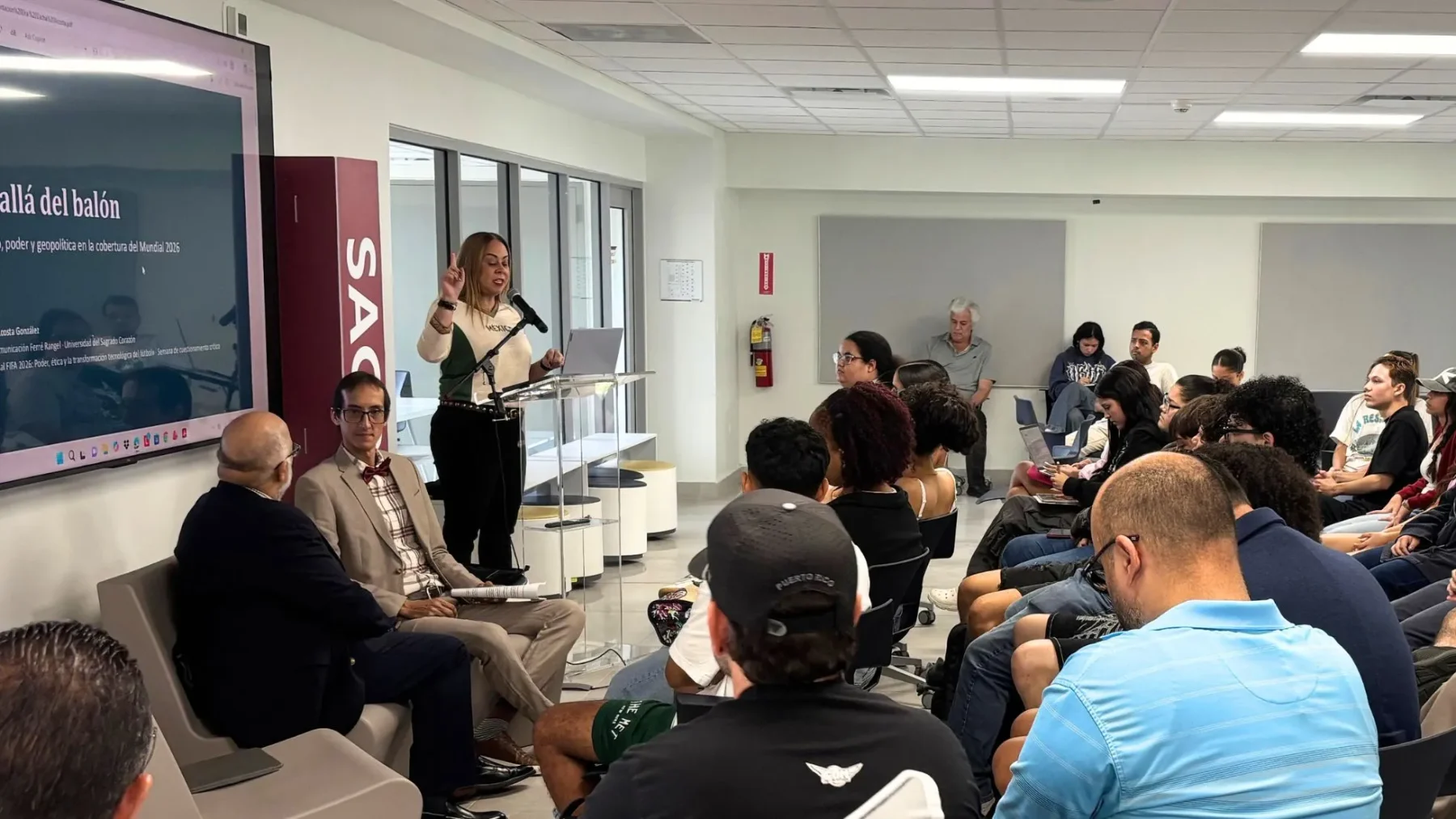
Sports go beyond goals, victories, and championships. Its relationship with politics, FIFA’s ethical challenges, and the role of the media were among the topics discussed during the talk 2026 FIFA World Cup: Power, Ethics, and the Technological Transformation of Soccer, held on Thursday, October 8, at Universidad del Sagrado Corazón.
The event was part of the Second Critical Inquiry Week, organized by the School of General Education to foster spaces for reflection and dialogue on the challenges people face in the 21st century.
The discussion featured professors José R. Rivera González and Ángel L. Rivera Torres, from the School of General Education, along with Zacha I. Acosta González, a sports journalist, Sagrado alumna, and professor at the Ferré Rangel School of Communication.
Rivera González opened the discussion by questioning whether sports can be separated from politics. During his presentation, he explained how international competitions represent national identities, power relations, and decisions that extend beyond the sporting arena.
Drawing on historical examples, including the 1972 Munich Olympics and the 1980 Moscow Olympics, the professor invited attendees to examine how political events also shape the history of sports.
Rivera Torres, in turn, addressed the ethical challenges facing FIFA, particularly those involving transparency, fairness, and institutional accountability. He also discussed the integration of technological tools into officiating, such as sensors in soccer balls and video review systems, which aim to reduce human error.
However, he emphasized that technological advances do not replace the need to ensure that decisions are understandable, fair, and respectful of all participants.
From a sports journalism perspective, Acosta González highlighted the importance of examining who tells the stories of major sporting events and how information is presented to audiences. She discussed issues related to media coverage of immigration policies, access to competitions, and the differences between the methods media outlets use to measure their audiences.
“Sports generate conversations that are necessary to continue expanding our understanding of everything connected to them. Sports involve ethics; sports involve politics,” Acosta González said, explaining the importance of these academic spaces.
She also noted that analyzing sports makes it possible to integrate knowledge from different university disciplines, from managing an international event to understanding how information about it is communicated to millions of viewers.
The event concluded with a question-and-answer session and discussion in which attendees reflected on the ethical, political, and emotional decisions associated with sporting competitions.
Through this activity, the School of General Education promoted critical inquiry, one of the cross-cutting competencies of its 21st Century Skills component, as a tool for analyzing events of international significance from perspectives that extend beyond the spectacle of sports.
Similar Stories
Sagrado and CUD Present Findings on the Profile of SMEs in Puerto Rico
4th Literary Contest Recognizes Sagrado Students’ Literary Talent