
By Alex O. Calderón Cruz
Journalism Student
At three in the afternoon, on a street in Barrio Obrero, a door opens and children begin to arrive. Some come with worn-out backpacks, still wearing their school uniforms, and many carrying stories too heavy to fit inside a classroom. Inside, they are not welcomed by a school, but by a home.
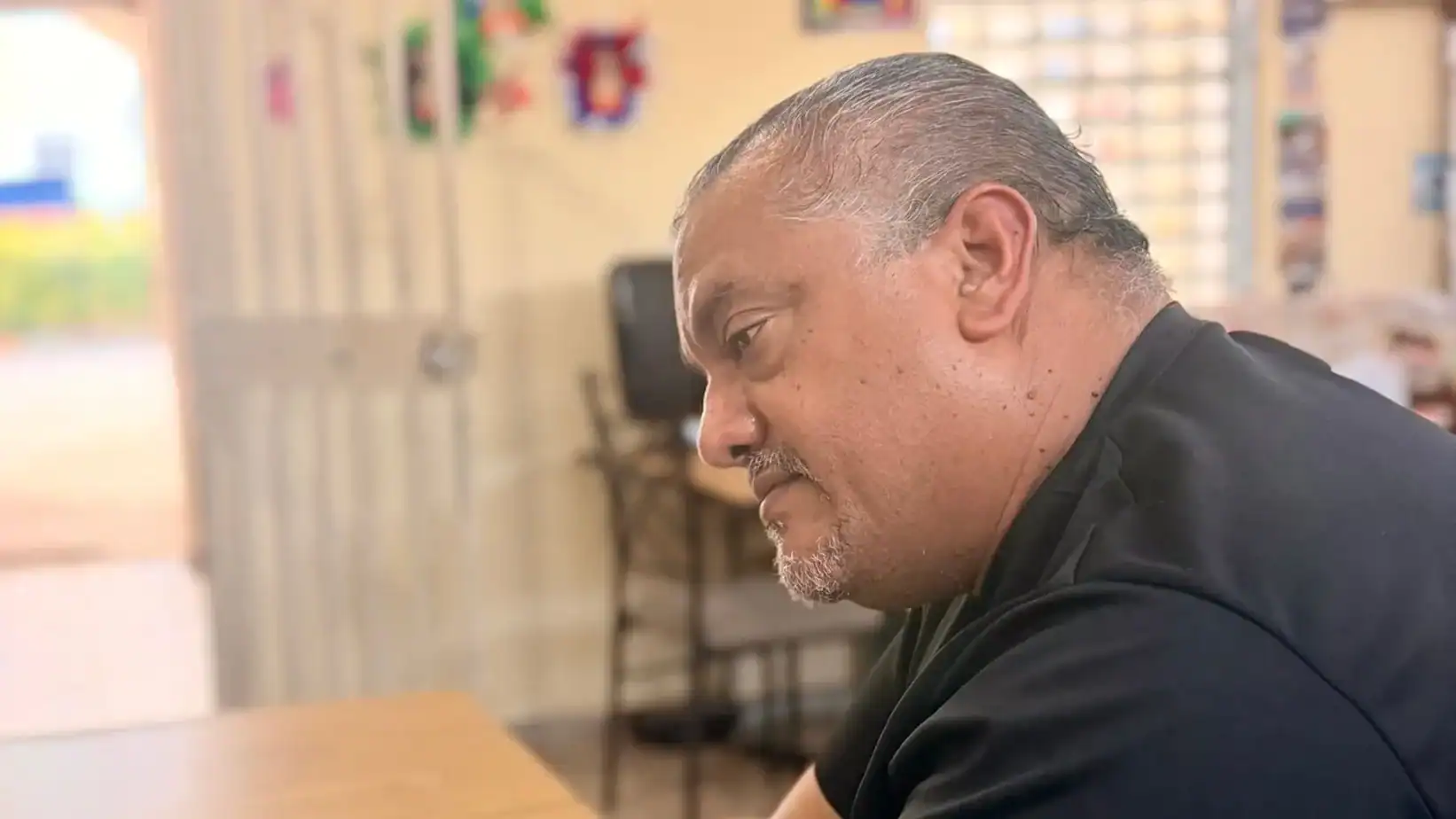
“If someone walks in here, that’s what they see… a home that embraces you,” says Roberto Rivera García as he watches the afternoon activity at La Casita de Amigos de Jesús. For the children, it is not a community center. It is their little home.
Roberto never truly left Barrio Obrero behind. Although he now lives in Loíza, he insists on returning almost every day, as if the neighborhood keeps calling him back to his roots. “I’m never going to abandon my roots. These are my roots. I grew up here, I was born here, and I feel happy here.” His story begins on those very same streets. He grew up in a household where material needs were never lacking — his father even built the first concrete house in the area — but deeper absences remained. His father struggled with alcoholism, and although there was always food on the table, he didn’t always have a truly present father. That absence left a mark on him.
“That’s what taught me not to be that way,” he says. Today, Roberto is the father of two grown children and a teacher who overflows with the affection and love he himself once lacked.
Before becoming an educator, he considered becoming a pharmacist. It was a practical decision, guided by financial stability. But after immersing himself in the world of science, he realized that was not where he belonged. “I’m an active person, always moving around… my thing is working with people.” He found his calling in education, and he has never let go of that path since. For Roberto, being a teacher does not end when the classroom door closes. At Facundo Bueso School, where he works, he transformed the walls into a museum: 24 murals designed by him and painted alongside his students. His classroom looks unlike any other, filled with beautiful and colorful murals.
At one point, they wanted to paint over them. His response was clear: if they touched his murals, he would chain himself to the school gate and make a “scene.” It was not just a threat. He wrote to the Secretary of Education, defended his space, and succeeded in protecting the artwork. “That belongs to the students,” he insists. Roberto defends what is his, his students often included.
La Casita de Amigos de Jesús was born out of an unexpected opportunity. The property belonged to Hogar Crea and was being auctioned off. It eventually ended up in the hands of his nonprofit organization. Over time, Roberto and his wife — who is also a teacher — transformed it into something greater. From Monday through Wednesday starting at three in the afternoon, the place fills with life. There are not only tutoring sessions. There are snacks, theater classes, music, dance, and art. There is literacy education for adults who never learned how to read. There are also young people who come to complete community service hours and end up finding a sense of purpose. There is faith as well: children prepare there for First Communion, but more importantly, people are shaped and nurtured there.
The children who arrive come from difficult circumstances: extreme poverty, unstable homes, deteriorating housing conditions. Roberto describes them without embellishment: mold-covered walls, exposed roofs, deep deprivation. But inside the Casita, something changes. They feel safe, they feel seen, they feel at home.
One of the experiences that impacted him the most happened after Hurricane Maria. A family with four children lost everything. Their wooden home could not withstand the storm. Roberto and his wife did not hesitate. They welcomed the family into their own home for eight months. “The government didn’t help at all,” he recalls. It was the school, the church, and even a supermarket that contributed to rebuilding the family’s roof. More than any other story, that one defines his vocation.
But not everything is sacrifice. Roberto also lives through art. He teaches theater, sings with the Puerto Rico National Choir, spent more than 20 years in the choir of Interamerican University, and currently sings with the Cantera Choir. He has no free time. Or rather, his free time is spent doing what he loves.
Every year, the Casita produces a musical: Jesus Christ Superstar, The Life of Saint John Bosco, Dominic Savio. The children act, sing, and transform themselves. Through those productions, they also help fund the project.
“That’s how we make it work,” he says. Everything they do is voluntary.
Saint John Bosco, the priest who dedicated his life to young people, was the spark that ignited this project. Roberto found in him a model for living — one based on total selflessness. Despite the hardships, Roberto does not speak of Barrio Obrero as a lost place. He describes it with a single word: “Paradise.” For him, the neighborhood is not poverty; it is community. “When a storm comes, everyone comes together. If something is needed, people show up. There’s camaraderie.”
He acknowledges the problems — drugs, poverty, inequality — but also points to something he believes the media ignores. “The press only shows the bad things. They never talk about the professionals who come out of here.” That narrative, he says, has unfairly stigmatized the neighborhood.
Regarding the dredging of the Martín Peña Canal, his position is clear: it is necessary. “It’s fair,” he says. He knows there will be displacement, that not everyone will agree, but he also understands that without intervention, poverty will remain stagnant. It is a complex perspective, free of romanticism.
Roberto looks toward the future with hope. He imagines a Barrio Obrero with less crime, less poverty, and more opportunities.
He dreams of seeing young people thrive, play sports, and grow.
And above all, he dreams of continuity. He hopes that one day, the very same children from the Casita will continue the mission.
Once, while preparing for surgery, a nurse approached him. “I know you,” she said. Then she looked at the doctors and said, “Take good care of him… thanks to that teacher, I became a nurse.”
That moment, more than any formal recognition, summarizes his legacy.
In Barrio Obrero, where many see abandonment, Roberto Rivera García has built a home. One where education is not merely teaching. It is refuge, dignity, and love. And every day, at three in the afternoon, he opens its doors once again.
As a former school student myself, I am deeply moved by everything Roberto Rivera García does for his students and the children in his community. More teachers with the level of commitment and vocation that he and his wife possess are greatly needed. Today, with the challenges posed by technology, the lack of values taught at home, and peer pressure, teachers like them can make the difference between a student guided toward opportunities and one who loses their way.
Beyond the limitations of the system or the lack of government support, the story of Roberto Rivera García demonstrates how individual commitment can profoundly impact a community. His example compels us to rethink the role of educators in society and to recognize that, in many cases, change begins with a single person willing to serve.
Editor’s Note
This journalistic profile is the result of in-service learning experiences carried out as part of the course PER 223: Narrative Journalism, taught by Professor Mariliana Torres Pagán in collaboration with Sagrado’s Community Engagement Program, the Barrio Obrero Oeste se Reinventa Foundation, and the Caño Martín Peña Enlace Project.