
By Soyell Sabad Cabassa Serrano
Journalism Student
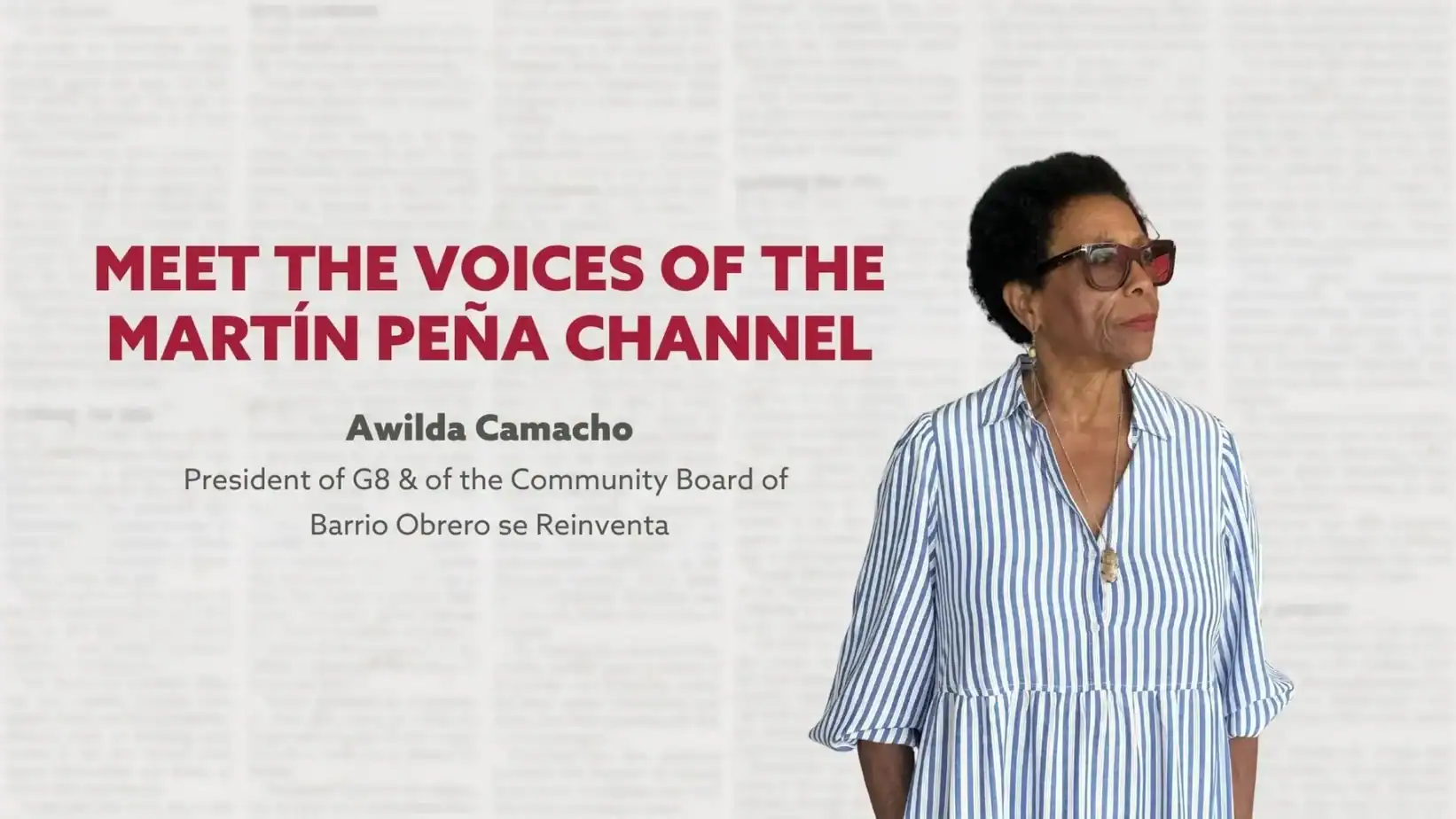
Every morning, before the heat takes over Santurce, Awilda Camacho Llanos begins her routine by walking through Barrio Obrero, greeting neighbors who recognize her as a community spokesperson. For years, she has addressed the neighborhood’s concerns: businesses closing, lack of lighting, garbage everywhere, families moving away, and a channel that threatens to flood their homes.
As she walks the streets, she does more than observe the problems: she remembers them. Awilda was born and raised in this very neighborhood, surrounded by culture and music, during a time when, although businesses were scarce, life felt closer and the doors of both homes and hearts were always open.
Awilda sums up her childhood in two words: challenges and culture. For her, the hardships of those days did not represent defeat; on the contrary, they were opportunities for growth. “The community wanted change, but at the same time people were content. Those were times when many residents faced economic limitations, even though they had professions; we were working class,” she said, gazing toward the horizon with a nostalgic look lost in thought.
Her parents, recognized as neighborhood commissioners, were the kind of people who helped their neighbors whenever someone was in need. In that environment full of leadership and service, Awilda grew up, developing an empathetic spirit that eventually became an essential part of her life’s mission.
That connection to her community shaped the course of her life. For years, she worked as a teacher and social worker, guiding young people both inside and outside the classroom. Over time, that sense of community took her to New York, where she continued her legacy of service to others, facing new realities that strengthened her vocation even further.
However, distance never broke her bond with Barrio Obrero. Even though she spent 26 years away from her community, Awilda never stopped thinking about the streets where she grew up or the people who watched her come of age.
When she returned to Puerto Rico, she did not come back as a visitor. She returned with the certainty that she still had more to contribute to her neighborhood and with the conviction that her voice could rise more strongly against the problems facing her community.
As soon as she saw the neighborhood again, alongside the joy of returning came sadness. “Barrio Obrero is not as populated as it once was. There are many empty and abandoned houses, and that makes me sad,” she expressed, filled with conflicting emotions.
As president of G8 and Barrio Obrero Se Reinventa, organizations that work to improve the quality of life in the sector, Awilda has promoted several initiatives to address community issues. Among them is her work surrounding the Martín Peña Channel, as well as efforts to manage abandoned homes and debris through ongoing dialogue with the relevant authorities.
Within that same commitment to the community, her most significant achievement has been the founding of the Barrio Obrero Festival, a cultural initiative that seeks to highlight the neighborhood’s history, culture, and music, becoming a space for expression, gathering, and identity for residents.
Reflecting on her life, she describes herself as a woman devoted to her community. “I describe myself as a fighter, combative, an activist, direct, passionate, and someone who cares for and looks after her community,” she said, her eyes filled with tears.
Awilda Camacho Llanos says she would like to be remembered as a self-aware Black woman, proud of her identity and roots, who has dedicated her life to sharing knowledge and fighting for her community.
At the end of the day, Awilda continues walking through the streets of the neighborhood that saw her born, now not only as a resident, but as one of the most prominent voices insisting that Barrio Obrero not disappear into abandonment and forgetfulness. Because as long as she walks its streets, the neighborhood has someone to name it, someone to defend it, and someone to dream for it.
Editor’s Note
This journalistic profile is the result of in-service learning experiences carried out as part of the course PER 223: Narrative Journalism, taught by Professor Mariliana Torres Pagán in collaboration with Sagrado’s Community Engagement Program, the Barrio Obrero Oeste se Reinventa Foundation, and the Caño Martín Peña Enlace Project.