
Below we reproduce, in full, the valedictory address of the Class of 2026 Valedictorian.
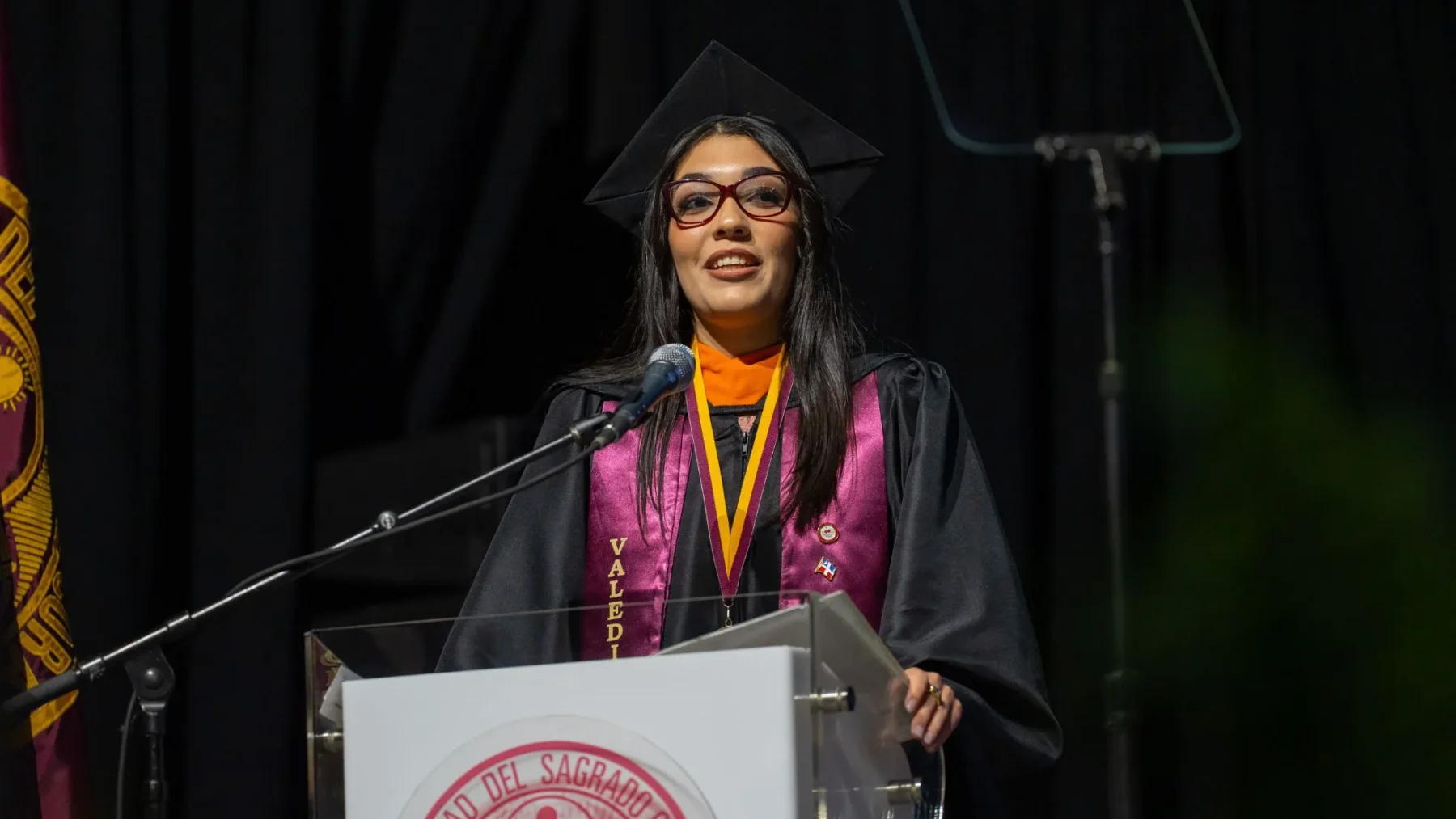
(Institutional Communications)
This story was originally published in La Península magazine, which is part of the EntreMedios co-curricular project in the Journalism program at the Ferré Rangel School of Communication.
Good morning, members of our university community, faculty, family, friends, and fellow graduates.
There are moments in history when a generation must decide who it wants to be. That is the central reflection I wish to share with you this morning.
Today we celebrate an academic achievement, yes—but we also celebrate something deeper: the opportunity to ask ourselves who we want to become and what we will do with the education we have received.
And perhaps, to answer that question, we must first revisit our own stories.
My name is Tanairy Soto Rodríguez. My story begins in Lares with a family that taught me that dreams are not determined by where we are born, but by the determination with which we choose to pursue them.
From an early age, I faced challenges in school. As a student with attention deficit hyperactivity disorder (ADHD), I was often seen as a restless or distracted child. Yet behind that energy was something much greater: a deep curiosity to learn and a genuine desire to help others.
Ever since I was very young, I dreamed of attending university. Not because I believed a diploma would solve every problem, but because I understood that education has the power to transform lives. Education allows us to discover who we are, develop our talents, and break patterns that for generations seemed impossible to change.
I remember a moment that changed my life. My parents told my sister and me that although they had not had the opportunity to complete their college education because of the circumstances of their time, they would do everything possible to ensure that we could achieve our dreams. They promised they would never clip our wings and that, whether resources were available or not, they would do everything within their power to help us go far.
Those words became a family promise and a responsibility that I embraced with gratitude and commitment.
Over time, I came to understand something important: my story was not an exception. In every one of these seats are people who also know the sacrifice, uncertainty, and hard work it takes to make it here.
Because this ceremony does not bring forward just one story. It brings together the stories of an entire generation.
In every one of these seats are stories of perseverance and hope. There are first-generation college students. There are young people who worked while studying, who supported their families, who faced financial hardship, health challenges, social barriers, or personal struggles that often went unseen.
As someone from Lares who moved to Santurce to study, I have no doubt that the young people from our towns—whether from the countryside, the coast, or the city—have the ability to go as far as they dare to dream. To do so, they need access to opportunities and support networks.
I experienced this firsthand during my time at Sagrado. The Student Support Program accompanied me throughout my journey as a first-generation college student. The institutional scholarships I received during my years of study constantly reminded me that someone had invested in my future. I hope that, in the not-too-distant future, many of us here today will be able to give back to our university through its Scholarship Program.
Likewise, experiences in projects such as EntreMedios, volunteer work, internships, and international opportunities broadened my view of the world and helped me understand something fundamental: the university exists not only to prepare professionals, but also to shape citizens who are capable of thinking critically about the reality they inherit and the future they wish to build.
My civic education at Sagrado included a student exchange at the Jesuit University of Guadalajara in Mexico. There I confirmed that education remains an unattainable opportunity for millions of people.
In Mexico, approximately 38.7 percent of children and adolescents live in poverty, representing nearly 14 million people. In addition, around 6 million children and young people do not attend school. Behind those statistics, I encountered real stories that forced me to reflect on the privilege enjoyed by those of us who have access to education.
Upon returning from my exchange experience, I realized that Puerto Rico also faces one of its greatest social challenges: poverty. Nearly 37 percent of our population lives below the poverty line, and more than half of our children grow up in households facing economic hardship. We have also witnessed the ongoing struggles to defend access to quality education and to protect educational institutions that are essential to our country.
At the same time, thousands of students in the Special Education Program continue to face barriers in accessing the support and resources they need to fully develop their potential. Behind every statistic are young people with extraordinary talents, abilities, and aspirations who deserve real opportunities.
These realities compel us to look beyond our individual stories and connect with our shared story.
The story of a generation that has had access to a university education and now graduates at a time marked by social, economic, technological, and political challenges. A generation that has grown up watching many people question the value of the university education we have received, while inequality continues to grow and indifference risks becoming routine.
But we are also a generation that knows the university remains the most powerful tool for transforming societies.
Because the university teaches us to analyze, question, investigate, and understand the complexity of the challenges we face. It enables us to recognize injustice and teaches us that imagining and developing solutions is a shared responsibility.
The true meaning of this diploma is not found in the piece of paper we receive today. Its value lies in the decisions we will make from this moment forward.
From this generation will come journalists who will bring visibility to stories that have remained unheard. Entrepreneurs who will create opportunities for others. Educators, communicators, artists, healthcare professionals, and leaders committed to the common good.
We were not educated simply to find jobs or accumulate degrees. We were educated to develop sound judgment, understand problems, and dare to build solutions. Our university has given us a clear mission: to build justice and peace through every profession and in every space we inhabit.
Puerto Rico needs a generation capable of listening to diverse perspectives, building bridges instead of divisions, and recognizing that diversity of experience strengthens our communities.
We need a generation that is eager to think differently. A generation that understands that development cannot be measured solely by the unchecked accumulation of wealth, but by our ability to guarantee the dignity of every person, regardless of their background or circumstances.
My fellow graduates, in the end, generations are remembered for the questions they dared to ask and the answers they chose to build.
Our generation will have to answer how it will defend access to education, how it will confront inequality, how it will protect human dignity, and how it will use technological progress for the common good.
May this diploma represent more than a goal achieved.
May it reflect the struggles that enabled us to break the mold and begin a new chapter for our lives and for our country.
May it represent responsibility.
May it represent our commitment to those who came before us and those who will come after us.
May it represent our willingness to serve.
From our faith, let us remember the words of 1 Peter 4:10: “Each of you should use whatever gift you have received to serve others.”
Thank you very much, and congratulations, Class of 2026.